






Lexa ERP · Laundry

Software for industrial laundries in Tunisia

Every kilo counted. Every dinar explained.

From collection at the hotel to the monthly invoice, every bag, every batch and every dose of detergent is recorded. You know what a washed kilo costs, and what each hotel earns you.

Real screenshots of the software, demo data.

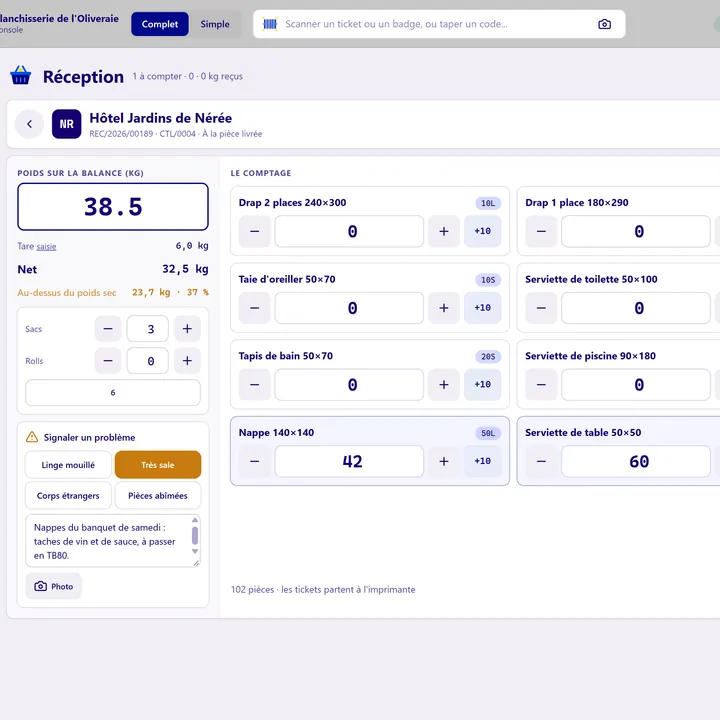
Laundry reception console: weighing the soiled linen and counting item by item
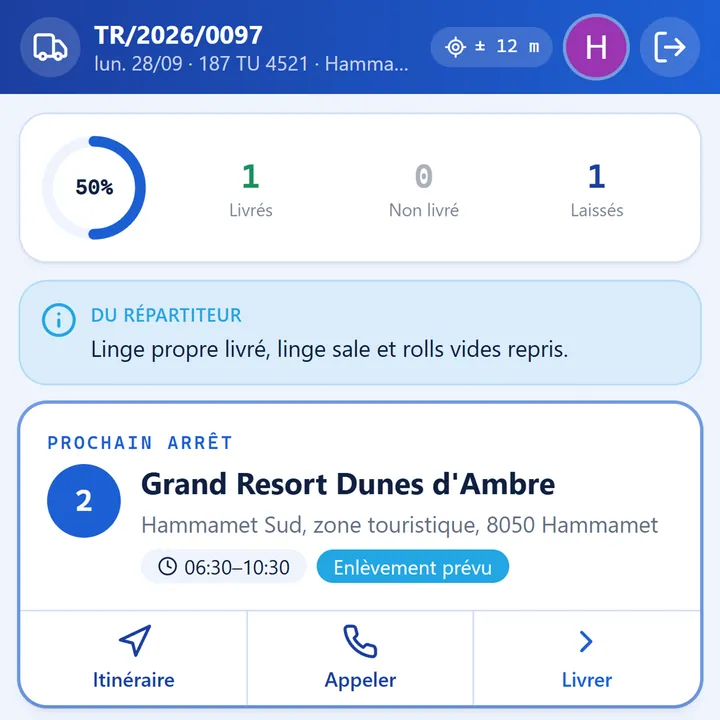
Laundry driver screen: hotel round, next stop and planned pick-up
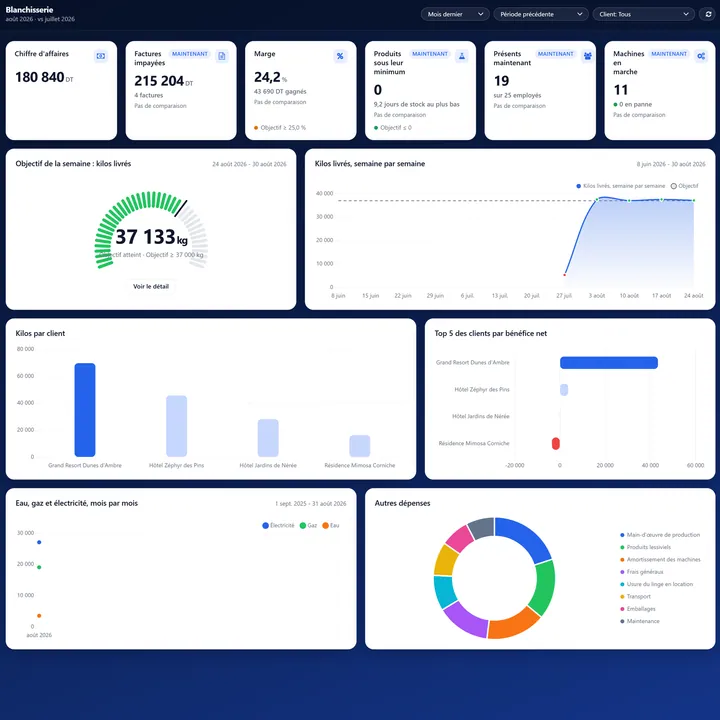
Management dashboard: revenue, unpaid invoices, margin, kilos delivered and costs

In brief

Lexa ERP for laundries is management software built for Tunisian industrial laundries that wash linen for hotels, clinics and restaurants. It follows the linen from collection at the customer's premises to the monthly invoice: bags counted at the hotel, weighing and counting at reception, batches with a barcode ticket, washing programme and doses, inspection at finishing, printed delivery note. Each hotel is invoiced once a month according to its contract — per piece, per kilo or as linen rental — based on what was actually delivered. The software also calculates the true cost of a washed kilo and each hotel's margin from the STEG and SONEDE bills, the chemicals used and the hours worked. Lexa ERP is published in Tunis by Lexa Technologies; pricing is quoted after a free audit.

The linen goes round, Lexa follows every step

From the truck to the invoice, one system: no more counting notebooks, no more disputes without proof.

  1. Collection

    at the hotel

  2. Reception

    weighed, counted

  3. Washing

    programme, dose

  4. Finishing

    ironed, folded

  5. Dispatch

    note printed

  6. Invoice

    once a month

What most laundries live with

The same difficulties come up among laundries working for hotels with notebooks, paper notes and Excel.

  • Counting disputes with hotels

    « Sheets are missing », « we never received anything »: without a dated and signed count, it is one party's word against the other's.

  • An unknown cost per kilo

    Invoicing is done per kilo or per piece without knowing what a washed kilo really costs once energy, water, products and hours are counted.

  • Chemicals running out too fast

    Doses added by hand and badly set small machines use more than planned, without anyone seeing it.

  • Batches lost in the workshop

    Between reception, the machines and finishing, nobody knows where a hotel's linen is or why it is late.

  • A monthly invoice rebuilt by hand

    Adding up each hotel's delivery notes at month end takes days and lets errors slip through.

  • Hotels that cost more than they bring in

    A per-kilo contract far from the laundry, heavily soiled linen: without a calculation per customer, the loss goes unnoticed.

Guided tour, step by step

A hotel's linen through Lexa, from collection to the cost per kilo. Click a screenshot to enlarge it.

Real screenshots from the Lexa ERP demo. The companies, customers and amounts shown are fictitious.

Step 1

At the hotel: the driver counts the bags

In the morning, the driver loads the truck line by line: the round only leaves if the load matches the delivery notes. At the hotel, he delivers the clean linen, then records the soiled linen he takes away: the number of bags, the trolleys taken back or left, the weight if it is weighed and a photo if needed. Each collection directly opens a reception to be counted at the laundry.

  • Load checked before departure
  • Clean linen delivered item by item
  • Bags, trolleys taken back or left, photo: the collection is proven
  • Each stop has its time: no more « nothing received »

Load checked
Laundry truck load checked line by line: sheets, duvet covers, towels, tablecloths
Clean linen delivered
Delivering clean linen to the hotel, quantity per item
Soiled linen collected
Collecting soiled linen at the hotel: number of bags, trolleys taken back, note and photo
Back at the depot
Back at the depot: round completed, bags collected and trolleys left or taken back

Step 2

Reception: weighed, counted, sorted into batches

At reception, the soiled linen is weighed, the trolley tare is deducted, then every item is counted. This count is the one that will be invoiced: it is authoritative with the hotel. Any problem — wet linen, torn linen, a forgotten object, very soiled linen — is recorded with a photo. The linen is sorted into batches by family, colour and hotel, and each batch receives a ticket with its code.

  • Weighing with the trolley tare deducted
  • Item-by-item count, used as the basis for the invoice
  • Problems recorded with a photo
  • One ticket per batch: barcode, QR code, programme and instructions
Reception: weighing, tare, counting and problems.
Reception console: weight on the scale, tare, net weight, count per item and problem reporting
The batch ticket, read at every station.
Printed batch ticket with barcode, QR code, hotel, washing programme, doses and finishing instructions

Step 3

Washing: the right programme, the right dose

In the washing area, every machine is free or running, with its programme, its kilos and the batches inside. Scanning the ticket opens the batch record: programme, temperature, duration, each chemical in grams for the batch's kilos, and the machines allowed. Incompatibilities are flagged before loading. The actual temperature is recorded for every wash, and a dose added by hand is recorded with its reason.

  • Machine status live: free, running, time remaining
  • Doses calculated in grams for the batch's kilos
  • Instructions and incompatibilities shown at the right moment
  • Temperatures and manual doses recorded: hygiene can be proven
The machines, loads in progress and batches waiting.
Washing area: washer-extractors and tunnel washer, load in progress and batches waiting
The batch record: programme, doses, instructions.
Batch record: allowed machines, programme at 80 °C, dose of each product in grams and instructions

Step 4

Finishing: what is not perfect goes back

At finishing, ironer or folding, the operator declares the good pieces and those set aside — to rewash, to repair or beyond use — with the defect found. The rewash goes back with its own ticket. The most frequent defects are ranked by hotel, the rewash rate is tracked every month against the target, and hotel complaints are linked to the delivery concerned.

  • Rejected pieces with their defect: stain, tear, wear
  • Rewash tracked with its own ticket
  • Defects ranked by hotel and by type
  • Complaints linked to the delivery concerned
Finishing: good pieces and rejected pieces, with the defect.
Finishing station: batches waiting and declaring pieces to rewash, repair or discard with the reason
The most frequent defects, hotel by hotel.
Table of defects by type and by hotel: wear, tears, stains, yellowing

Step 5

Dispatch: the delivery note prints itself

The console shows what is ready for each hotel. Packing is done for the next day: finished batches are proposed, with their weight and trolleys. On confirmation, prices are fixed, the delivery note is created for the morning round and printed in two copies: one for the hotel, one signed that comes back with the driver. For a small laundry, a simple mode keeps only reception and confirmation for delivery.

  • Finished batches proposed automatically, hotel by hotel
  • Pieces, clean weight and trolleys on the note
  • Two copies: one for the hotel, one signed that comes back
  • Simple mode for small laundries
The dispatch prepared for the morning round.
Preparing a dispatch for a hotel: finished batches, trolleys, clean weight and number of pieces
The printed delivery note.
Laundry delivery note: hotel, contract, trolleys, clean weight, pieces per item and batches

Step 6

One invoice per hotel, every month

Each hotel has its contract: invoiced per piece, per kilo, or as rental of the laundry's own linen, with a monthly minimum if needed. At month end, Lexa draws up one invoice per hotel from what was actually delivered, summarised by item, with a statement of every delivery note. For rented linen, pieces lost beyond the tolerance set in the contract are invoiced at replacement price.

  • Contracts per piece, per kilo or as rental
  • Monthly minimum and loss tolerance per contract
  • Compliant invoice: VAT and stamp duty
  • Statement of deliveries attached, note by note
The hotel's contract.
Linen rental contract with a hotel: items, weight, price per piece, monthly minimum and loss tolerance
The monthly invoice.
Monthly laundry invoice to a hotel: quantities per item, VAT, stamp duty and list of deliveries
The statement of deliveries.
Statement of the month's deliveries attached to the invoice: every note, day by day and item by item

Step 7

Chemicals: planned dose, actual dose

Every wash records what it should have used according to its programme, and what it actually used if the operator added a dose. The comparison is made by machine, by hotel and by product: gaps stand out, for example a small machine dosing for its full capacity. Every night the doses are deducted from stock; below the minimum, a purchase order in whole drums is prepared, for confirmation.

  • Theoretical and actual consumption, by machine and by hotel
  • Stock deducted every night and recounted every week
  • Supplier order prepared below the minimum level
Planned and actual dose, machine by machine.
Chemical consumption by machine: theoretical, actual, difference and quantity needed
Replenishment prepared automatically.
Chemical replenishment rules: available stock, minimum, maximum, quantity to order

Step 8

The true cost per kilo, hotel by hotel

Every month, Lexa closes the costs: STEG and SONEDE bills (electricity, gas, water), products used, hours of attendance, machine depreciation and maintenance, transport. Each amount is allocated between the hotels according to what their linen actually used: machine hours, water, gas, minutes of work. You get the cost per kilo, the revenue per kilo and each hotel's margin — including the one losing you money without anyone noticing.

  • Energy and water at the real cost of the month's bills
  • Labour from the hours of attendance
  • Allocation based on each hotel's actual consumption
  • Margin and cost per kilo by customer
The month's cost closing.
Monthly cost closing: electricity, gas, water, products, labour, transport, depreciation, maintenance
Margin and cost per kilo, hotel by hotel.
Profitability by hotel: kilos washed, revenue, costs, margin and cost per kilo

Step 9

The management dashboard

A single screen brings together revenue, unpaid invoices, margin, products below their minimum, staff present today, machines running and machines down. Below: kilos delivered this week against the target, their trend week after week, kilos per hotel and the most profitable hotels. Each indicator turns green, orange or red according to its target, and one click opens the details.

  • Revenue, unpaid invoices and margin
  • Stock, attendance and state of the machine fleet
  • Kilos delivered by week and by hotel
The management indicators.
Management indicators: revenue, unpaid invoices, margin, products below minimum, staff present, machines running
Kilos delivered against the target.
Weekly target of kilos delivered and trend week after week
Kilos and profit by hotel.
Kilos per customer and ranking of customers by net profit

Everything you need, in one tool

Ten modules sharing the same database: a hotel, an item or a machine exists only once.

  • Hotel contracts

    Per piece, per kilo or rental, with a monthly minimum.

  • Rounds and collections

    Deliveries and pick-ups planned hotel by hotel.

  • Driver screen

    Loading, delivery, collection of bags and trolleys.

  • Batches and tickets

    Barcode and QR code, instructions, each batch's journey.

  • Chemicals

    Planned and actual doses, stock, replenishment.

  • Machine fleet

    Machines running or down, maintenance requests.

  • Cost per kilo

    Monthly cost closing and margin by hotel.

  • Quality

    Rewashes, defects and complaints for your quality system.

  • Dashboard

    Revenue, unpaid invoices, margin, kilos, attendance.

  • Delivery notes

    Printed in two copies, signed on return.

Why Lexa for your laundry

Four concrete differences when it's time to choose.

  • Built for hotel linen

    Hotel contracts, trolleys, trolley tare, batches per hotel, linen rental: Lexa starts from the trade of the industrial laundry, not from an adapted dry-cleaner point-of-sale program.

  • Proof at every step

    Collection counted at the hotel, a reception count that is authoritative, photos of problems, a signed delivery note that comes back: every dispute is settled with a dated document.

  • Known margins, hotel by hotel

    STEG and SONEDE bills, chemicals used and hours of attendance are allocated according to each hotel's actual consumption: you know which one is profitable.

  • Local, from contract to invoice

    Invoices in dinars with VAT and stamp duty, a team in Tunis to set up the software with your hotels, items and machines, support in French and Arabic.

Pricing: on quotation, after a free audit

The price depends on your laundry: number of machines and stations, number of hotels and rounds, invoicing models, migration of your items and contracts. It is set after a free audit, with no commitment.

The model is that of Lexa ERP: a licence and annual maintenance in dinars, with no per-user fee. Every operator, driver and manager has an account.

Frequently asked questions — laundry software

The questions business owners in this trade ask us most often.

An industrial laundry needs software that follows the linen from collection at the customer's premises to the monthly invoice: counting at the hotel and at reception, batches traced through the workshop, washing doses, inspection at finishing, delivery notes and invoicing according to the contract. Lexa ERP for laundries covers these steps in a single system, published and set up from Tunis, with compliant invoices (VAT and stamp duty).

See it with your own figures

Thirty minutes to review your flows and see Lexa on your business. Free audit, no commitment, reply within 24 working hours.

See also: The tourism and hospitality sector · all solutions by trade

Illustrations: Microsoft Fluent Emoji, MIT licence.